JSON vs YAML: Which One Should You Use in 2026?
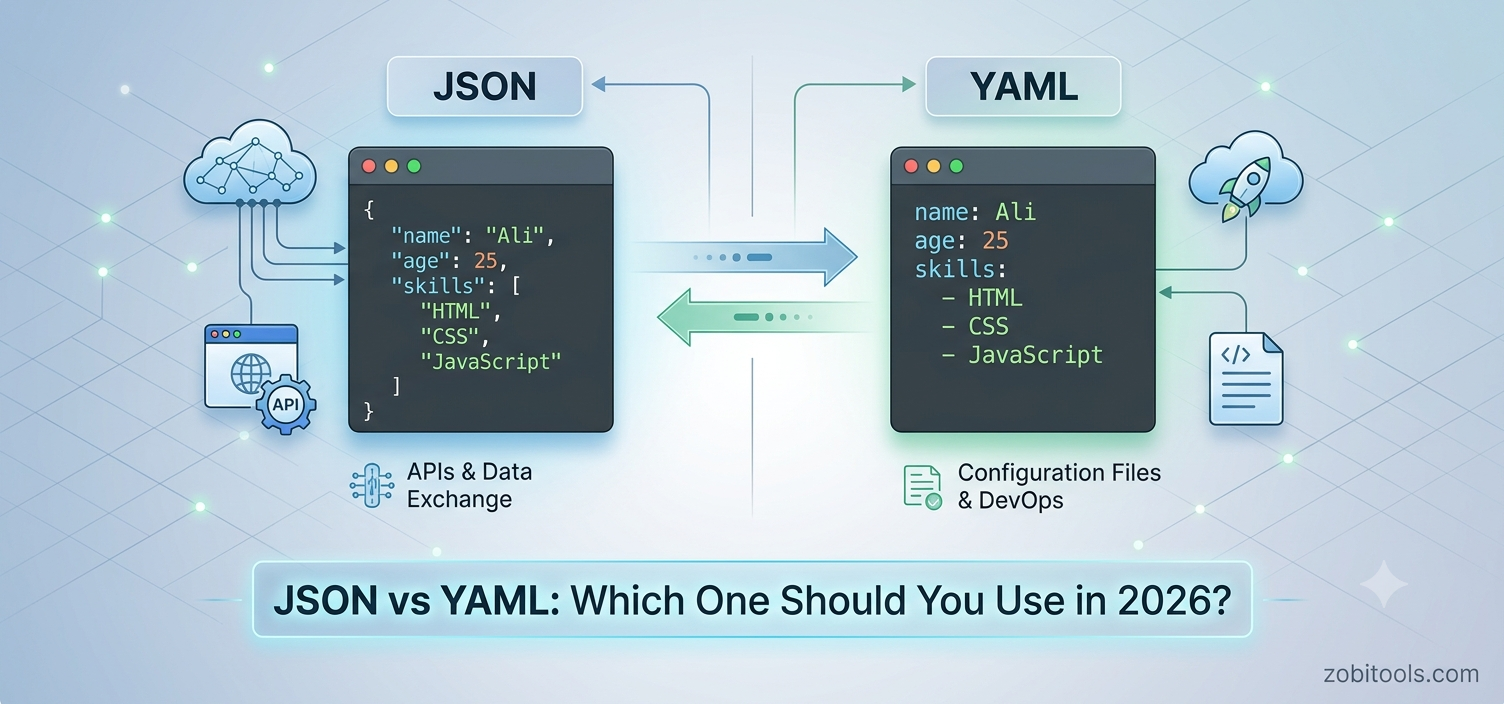
JSON vs YAML: Which One Should You Use in 2026?
Understanding differences, use cases, and real-world applications
Choosing between JSON and YAML depends on your use case, not personal preference. Both are widely used for APIs, configuration files, and data exchange in modern systems.
📌 What is JSON?
JSON (JavaScript Object Notation) is a lightweight format used to store and exchange structured data.
Key Features
- Easy to read and write
- Strict syntax rules
- Language-independent
- Widely used in APIs
{
"name": "Ali",
"age": 25,
"skills": ["HTML", "CSS", "JavaScript"]
}
📌 What is YAML?
YAML (YAML Ain’t Markup Language) is a human-readable format mainly used for configuration files.
Key Features
- Highly readable
- Uses indentation instead of brackets
- Supports comments
- Flexible but indentation-sensitive
name: Ali
age: 25
skills:
- HTML
- CSS
- JavaScript
📊 Key Differences
| Feature | JSON | YAML |
|---|---|---|
| Readability | Moderate | Very high |
| Syntax | Strict | Flexible |
| Comments | Not supported | Supported |
| Best Use | APIs, data exchange | Config files, DevOps |
⚡ Usage in 2026
Both formats are still widely used in modern development.
- JSON dominates APIs, frontend apps, and backend communication
- YAML dominates DevOps, CI/CD, and infrastructure configuration
🧠 Which One Should You Use?
Use JSON if:
- You are building APIs
- You need fast data transfer
- You work with React / Next.js
- You need strict structure
Use YAML if:
- You work in DevOps
- You write config files
- You need readability
- You want comments support
🏁 Final Verdict
There is no single winner between JSON and YAML.
JSON is best for structured data exchange.
YAML is best for readable configuration files.
Modern systems use both depending on the context.
Ready to clean and optimize your JSON?
Use our free JSON Formatter Tool to format, validate, and minify JSON instantly.
Open JSON Formatter Tool