JSON vs XML: Differences and Use Cases
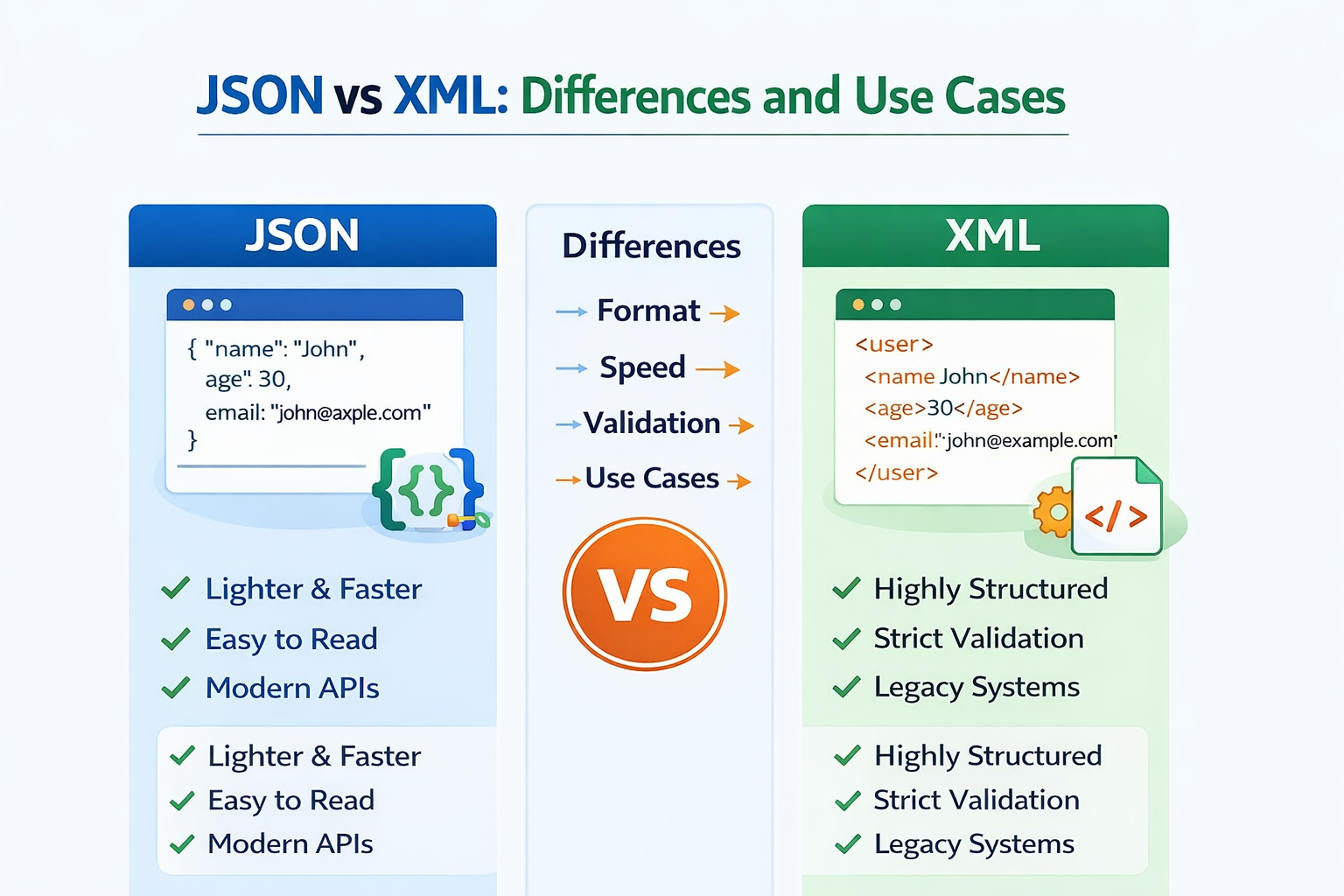
Figure: JSON vs XML comparison diagram
In today’s software development world, data exchange is the backbone of APIs, web applications, and distributed systems. Two of the most widely used data formats for structuring and exchanging data are JSON and XML.
While both serve similar purposes, they differ significantly in syntax, performance, readability, validation, and real-world use cases.
This complete guide explains the differences between JSON and XML, provides clear examples, and helps you decide which one to use and when.
What Is JSON?
JSON (JavaScript Object Notation) is a lightweight data-interchange format that is easy for humans to read and write and easy for machines to parse and generate.
Although it originated from JavaScript, JSON is language-independent and supported by almost every programming language.
{
"name": "John",
"age": 30,
"email": "john@example.com"
}
Key Features of JSON
- Lightweight and compact format
- Easy to read and write
- Fast parsing and processing
- Native support in JavaScript
- Widely used in APIs and modern web applications
What Is XML?
XML (eXtensible Markup Language) is a markup language designed to store and transport data using custom tags.
It focuses more on structure, validation, and extensibility, making it suitable for complex and document-oriented systems.
<user>
<name>John</name>
<age>30</age>
<email>john@example.com</email>
</user>
Key Features of XML
- Highly structured format
- Supports complex data models
- Strong validation using DTD or XSD
- Widely used in legacy and enterprise systems
- Self-descriptive and extensible tags
JSON vs XML: Key Differences
| Feature | JSON | XML |
|---|---|---|
| Format | Key-value pairs | Tag-based |
| Readability | Very easy | Verbose |
| File Size | Smaller | Larger |
| Parsing Speed | Faster | Slower |
| Validation | Limited | Strong (DTD/XSD) |
| Data Types | Native types | Text only |
| Comments | ❌ No | ✅ Yes |
| API Usage | Very common | Less common |
Performance Comparison
- Faster to parse
- Smaller payload size
- Ideal for mobile and web apps
- Lower bandwidth usage
- Heavier due to tags
- Slower parsing
- Better for document-heavy data
👉 Winner for performance: JSON
Readability & Ease of Use
- JSON is clean, minimal, and readable
- XML becomes complex as data grows
- JSON works naturally with JavaScript
- XML requires more processing
👉 Winner for simplicity: JSON
Validation & Structure
XML excels when:
- Strict data validation is required
- Complex schemas are needed
- Industry standards apply
JSON validation exists (JSON Schema), but it is not as strict as XML.
👉 Winner for validation: XML
Real-World Use Cases
When to Use JSON
- REST APIs
- Web and mobile applications
- Frontend-backend communication
- Microservices
- Configuration files
- NoSQL databases
When to Use XML
- Enterprise systems
- SOAP web services
- Document storage
- Financial and government systems
- Legacy integrations
Conclusion
Both JSON and XML are powerful data formats with different strengths.
JSON dominates modern web development due to its speed, simplicity, and performance, while XML remains essential for enterprise-level and highly structured data systems.
Final Recommendation:
✔ Use JSON for APIs and web apps
✔ Use XML for complex, validated, document-based systems
Understanding when to use each format helps you build faster, cleaner, and more scalable applications.
Want to format or validate JSON instantly?
Try our free JSON Formatter Tool to clean and beautify JSON data.
Open JSON Formatter Tool