ISO Date vs Unix Timestamp: What’s the Difference and When Should You Use Each?
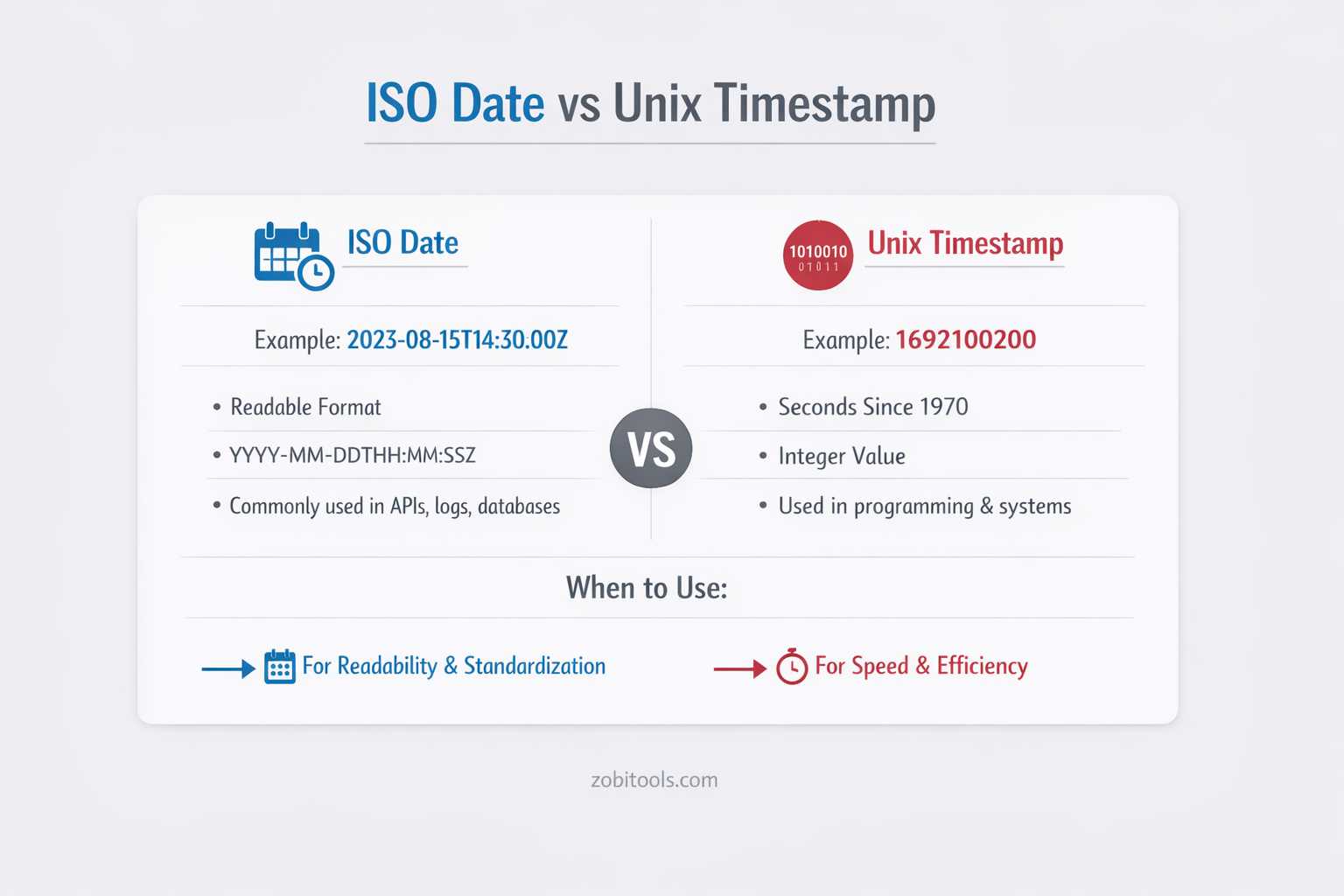
Figure: ISO Date vs Unix Timestamp
Dates and time formats are essential in software development, databases, and web applications. Two of the most widely used formats are ISO Date and Unix Timestamp. While both represent time, they serve different purposes and excel in different scenarios.
In this guide, you’ll learn:
- What ISO Date is
- What Unix Timestamp is
- Key differences between them
- Pros and cons
- When to use each format
- Real-world examples
Let’s break it down in simple terms.
What Is an ISO Date?
An ISO Date follows the international ISO 8601 standard, designed to represent dates and times clearly and consistently worldwide.
2026-02-07T14:30:00Z
Structure Explained
- 2026 → Year
- 02 → Month
- 07 → Day
- T → Separator between date and time
- 14:30:00 → Time
- Z → UTC timezone
Why Developers Like ISO Dates
- ✔ Human-readable
- ✔ Globally standardized
- ✔ Avoids date confusion (MM/DD vs DD/MM)
- ✔ Works great in APIs
- ✔ Easy debugging
ISO format is commonly used in:
- REST APIs
- JSON responses
- Cloud applications
- Logging systems
What Is a Unix Timestamp?
A Unix Timestamp represents time as the number of seconds that have passed since:
👉 January 1, 1970 (UTC) — also called the Unix Epoch.
1707316200
Instead of showing a readable date, it stores time as a single integer.
Why Developers Use Unix Timestamps
- ✔ Extremely fast for computers to process
- ✔ Perfect for sorting dates
- ✔ Saves database space
- ✔ Timezone-independent
- ✔ Ideal for calculations
Unix timestamps are widely used in:
- Databases
- Operating systems
- Backend logic
- Caching systems
- Authentication tokens
ISO Date vs Unix Timestamp: Key Differences
| Feature | ISO Date | Unix Timestamp |
|---|---|---|
| Format | Human-readable | Numeric |
| Example | 2026-02-07T14:30:00Z | 1707316200 |
| Easy to Read | ✅ Yes | ❌ No |
| Storage Efficient | ❌ Larger | ✅ Smaller |
| Sorting | ✅ Good | ✅ Excellent |
| Debugging | ✅ Easy | ❌ Hard |
| Performance | Slightly slower | Very fast |
Advantages of ISO Date
- Human-Friendly: Instantly understandable without conversion.
- International Standard: Prevents formatting confusion.
- Better for APIs: Most modern APIs return ISO-formatted dates.
- Easier Debugging: Developers can quickly identify issues.
Advantages of Unix Timestamp
- High Performance: Faster for computers to compare and process.
- Compact Storage: Uses less space in large-scale databases.
- Timezone Neutral: Always based on UTC.
- Perfect for Calculations: Time differences become simple math.
Example:
End - Start = Time Difference
When Should You Use ISO Date?
Use ISO Date if:
- ✅ Data needs to be human-readable
- ✅ You're building public APIs
- ✅ Logs must be understandable
- ✅ Debugging is important
- ✅ You want standardized formatting
Best For: Frontend apps, APIs, analytics dashboards, audit logs.
When Should You Use Unix Timestamp?
Choose Unix Timestamp if:
- ✅ Performance matters
- ✅ You handle millions of records
- ✅ You need fast sorting
- ✅ Storage optimization is important
- ✅ You're doing time calculations
Best For: Backend systems, databases, authentication, caching.
Pro Tip: Many Systems Use Both
Modern applications often store timestamps in Unix format but convert them to ISO dates when displaying them to users.
👉 Store numeric → Display readable
This approach combines performance with usability.
Convert ISO Date to Unix Timestamp
const isoDate = "2026-02-07T14:30:00Z";
const unixTimestamp = Math.floor(new Date(isoDate).getTime() / 1000);

console.log(unixTimestamp);
Convert Unix Timestamp to ISO Date
const timestamp = 1707316200;
const isoDate = new Date(timestamp * 1000).toISOString();

console.log(isoDate);
Common Mistakes Developers Make
- ❌ Forgetting Timezones — Always confirm whether your timestamp is UTC.
- ❌ Mixing Milliseconds and Seconds — JavaScript uses milliseconds, while Unix timestamps typically use seconds.
- ❌ Storing Readable Dates in Large Databases — This can impact performance.
Which Format Is Better?
There is no universal “best” format — it depends on your needs.
👉 Choose ISO Date for clarity. 👉 Choose Unix Timestamp for speed.
Best practice: Use both strategically.
Final Thoughts
Understanding the difference between ISO Date vs Unix Timestamp is crucial for developers, data engineers, and anyone working with time-based data.
- ISO Date improves readability and standardization.
- Unix Timestamp boosts performance and efficiency.
The smartest systems leverage both — storing time efficiently while presenting it clearly to users.
Need to Convert Dates Instantly?
Try our free Timestamp Converter Tool to switch between ISO dates and Unix timestamps in seconds.
Open Timestamp Converter