AI Keyword Finder vs Google Keyword Planner: Which Keyword Research Tool Is Better in 2026?
Frequently Asked Questions
What is an AI Keyword Finder?
An AI Keyword Finder is an SEO tool that uses artificial intelligence to discover keywords, related search terms, long-tail keywords, search intent, and content opportunities.
Is ZobiTools AI Keyword Finder free?
Yes, ZobiTools provides a free AI Keyword Finder designed to help users discover SEO keywords and content ideas.
What is the difference between AI Keyword Finder and Google Keyword Planner?
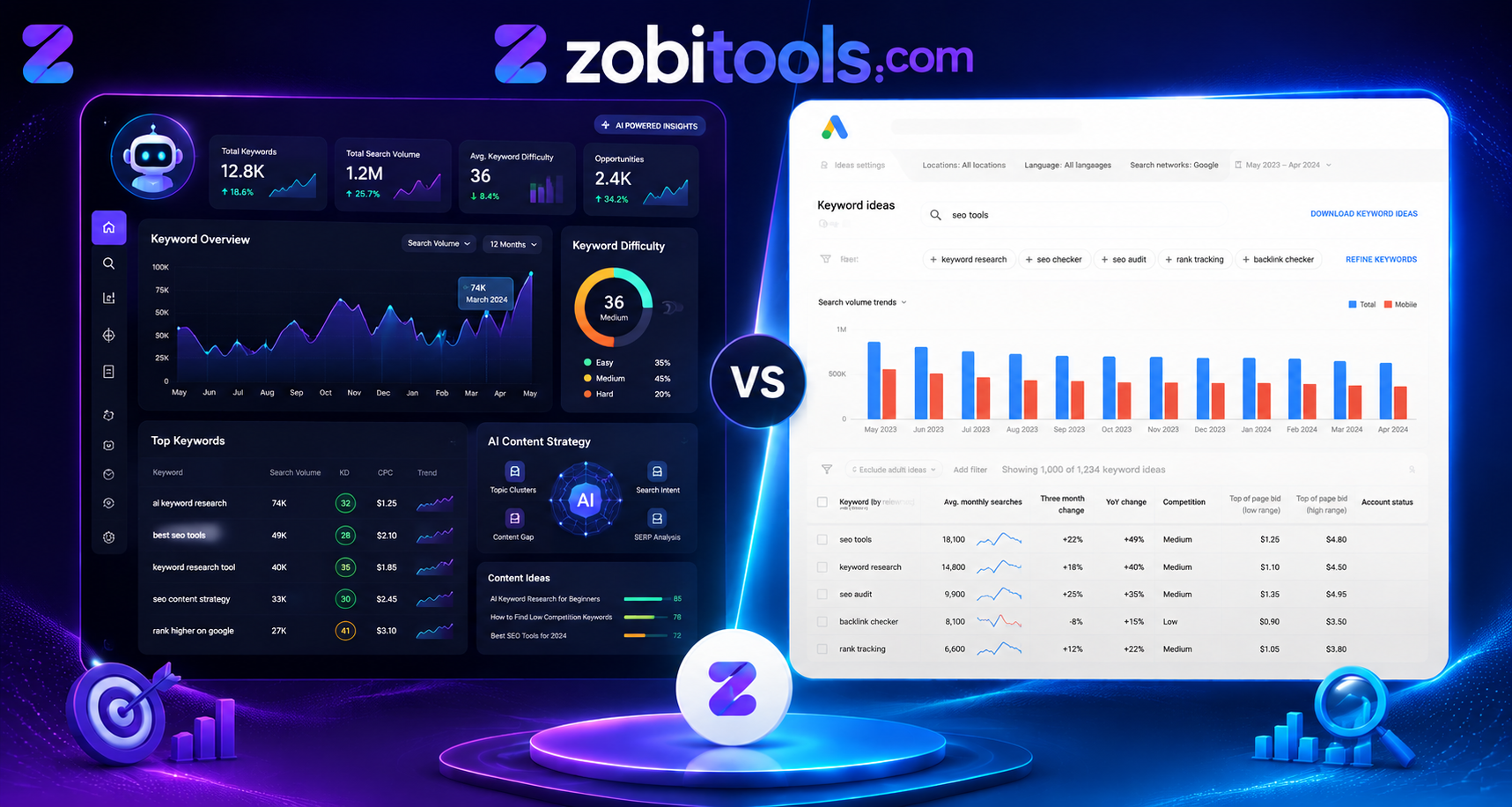
Google Keyword Planner focuses on advertising keyword research, while AI Keyword Finder focuses on SEO content planning, keyword discovery, and content optimization.
Are long-tail keywords important for SEO?
Yes. Long-tail keywords usually have lower competition and help attract more targeted visitors.
Can AI Keyword Finder generate blog ideas?
Yes. AI Keyword Finder can suggest topics, related keywords, questions, and content ideas based on your main keyword.
How often should keyword research be done?
Keyword research should be performed before creating new content and reviewed regularly to discover new opportunities.

AI Keyword Finder helps bloggers, marketers, and businesses discover profitable keywords, analyze search intent, and create better SEO strategies.
AI Keyword Finder: Free AI-Powered Keyword Research Tool for Better SEO
Keyword research is one of the most important parts of SEO.
Before publishing content, you need to understand:
- What people are searching for
- Which keywords have opportunities
- What questions users want answered
- How competitive a topic is
A modern AI Keyword Finder makes this process faster by combining artificial intelligence with SEO analysis.
Traditional keyword research often requires multiple tools. AI-powered keyword tools help simplify the workflow by generating keyword ideas, related searches, long-tail keywords, and content recommendations in one place.
If you are building a blog, affiliate website, SaaS product, or online business, keyword research helps you create content that matches real user searches.
Try the free ZobiTools AI Keyword Finder
AI Keyword Finder vs Google Keyword Planner: Key Differences
Both AI Keyword Finder and Google Keyword Planner are powerful keyword research solutions, but they are designed for different purposes.
Google Keyword Planner was created mainly for advertisers who want to discover keywords for Google Ads campaigns.
On the other hand, an AI Keyword Finder is designed for modern SEO workflows, helping content creators discover keywords, analyze search intent, generate content ideas, and build topic clusters.
Explore ZobiTools AI Keyword Finder
Comparison Table: AI Keyword Finder vs Google Keyword Planner
Feature | AI Keyword Finder | Google Keyword Planner |
|---|---|---|
Main Purpose | SEO content research and keyword discovery | Google Ads keyword planning |
Keyword Suggestions | AI-generated related keywords, long-tail keywords, and topic ideas | Keyword ideas based on Google search data |
Search Intent Analysis | Yes, helps identify informational, commercial, and transactional intent | Limited search intent insights |
Content Ideas | Generates blog topics, headings, and SEO suggestions | Does not generate complete content ideas |
Keyword Clustering | Helps organize related keywords into topic groups | No advanced clustering features |
Best For | Bloggers, SEO specialists, marketers, and content creators | Advertisers and PPC marketers |
How AI Keyword Finder Helps With SEO
Modern SEO is not only about finding keywords with high search volume.
Search engines analyze whether your content actually solves a user's problem.
An AI Keyword Finder helps you understand:
User Search Intent: Understand what users expect when searching.
Long-Tail Keywords: Discover specific phrases with lower competition.
Keyword Clusters: Create multiple articles around one main topic.
Content Opportunities: Find missing topics competitors may not cover.
SEO Optimization: Improve titles, headings, and article structure.
How Google Keyword Planner Helps With SEO
Although Google Keyword Planner is mainly designed for paid advertising, it still provides valuable keyword insights.
It can help you discover:
Average keyword search demand.
Related keyword variations.
Competition levels for advertising.
Potential keywords for SEO campaigns.
However, content creators usually need more than keyword volume. They need to understand:
- Why users search for a keyword.
- What type of content should be created.
- Which questions need answers.
- How keywords should be organized.
This is where AI-powered keyword research becomes useful.
Can AI Keyword Finder Replace Google Keyword Planner?
Not completely.
Both tools have different strengths.
A professional SEO workflow can combine both:
Step 1: Use Google Keyword Planner to discover keyword demand.
Step 2: Use AI Keyword Finder to expand keyword ideas, analyze intent, and create content strategies.
Step 3: Create useful content that answers real user questions.
Best Keyword Research Strategy for Content Websites
For websites like blogs, SaaS tools, and online utilities, the best strategy is creating topic clusters.
Example:
Main Topic:
AI Keyword FinderRelated Topics:
How to find SEO keywords
Best AI SEO tools
Keyword research mistakes
Long-tail keyword strategies
AI content optimization
By connecting related content together, websites can build topical authority and improve their chances of ranking.
Common Mistakes in Keyword Research
Even with powerful SEO tools, many websites struggle because they follow incorrect keyword research practices.
Avoid these common mistakes:
Targeting only high-volume keywords: High search volume does not always mean high-quality traffic.
Ignoring search intent: A keyword is valuable only when your content matches what users are looking for.
Not using long-tail keywords: Specific keywords often have lower competition and better conversion potential.
Creating content without keyword clusters: Single keyword targeting can limit your SEO growth.
Keyword stuffing: Repeating keywords unnaturally can damage user experience.
Ignoring competitor analysis: Understanding ranking pages helps create better content.
Not updating old content: Keyword trends change over time, so existing articles need improvement.
⚠ SEO Warning
Ranking is not only about finding keywords. Successful SEO requires understanding user intent, creating valuable content, improving website experience, and building authority.
SEO Tips for Better Keyword Research
Choose keywords that match your audience's problems.
Focus on long-tail keywords for easier ranking opportunities.
Use related keywords naturally throughout your content.
Create content clusters instead of isolated articles.
Answer frequently asked questions from real users.
Optimize your title, meta description, and headings.
Analyze competitors before creating new content.
Update older articles with new keyword opportunities.
Who Should Use an AI Keyword Finder?
An AI Keyword Finder is useful for anyone who wants to improve organic search visibility.
SEO Specialists
Bloggers and Content Writers
Affiliate Marketers
Digital Marketing Agencies
YouTube Creators
Business Owners
Startup Founders
Web Developers
AI Keyword Finder Use Cases
Use Case | How AI Keyword Finder Helps |
|---|---|
Blog Writing | Find article topics, keywords, and content opportunities. |
SEO Campaigns | Discover keyword clusters and optimize content strategies. |
Affiliate Marketing | Find commercial keywords with buyer intent. |
YouTube SEO | Generate video topics based on search demand. |
Content Planning | Build complete keyword-based content calendars. |
Final Verdict: AI Keyword Finder vs Google Keyword Planner
Google Keyword Planner remains an excellent tool for advertisers who need keyword data for Google Ads campaigns.
However, modern content creators need more than search volume numbers.
They need:
- Keyword ideas
- Search intent analysis
- Content planning
- Topic clusters
- SEO recommendations
This is where an AI Keyword Finder provides additional value.
For bloggers, SEO professionals, and website owners, combining AI-powered keyword research with traditional keyword data creates a stronger SEO workflow.
Find Better Keywords With AI
Discover keyword ideas, search intent, long-tail keywords, keyword clusters, and SEO recommendations with the free ZobiTools AI Keyword Finder.
Try AI Keyword Finder